Buses replacing trains
This page is for buses replacing trains during planned maintenance work.
If you're looking for bus replacement information during a disruption, see Service alerts(external link) for the most current information, and other resources in the Disruption guide.
Timetables
When a planned Buses Replacing Trains (BRT) event is happening, the rail services that are affected will be highlighted in pink on the website and app.
The BRT timetable is available as a PDF in various places on our website and app.
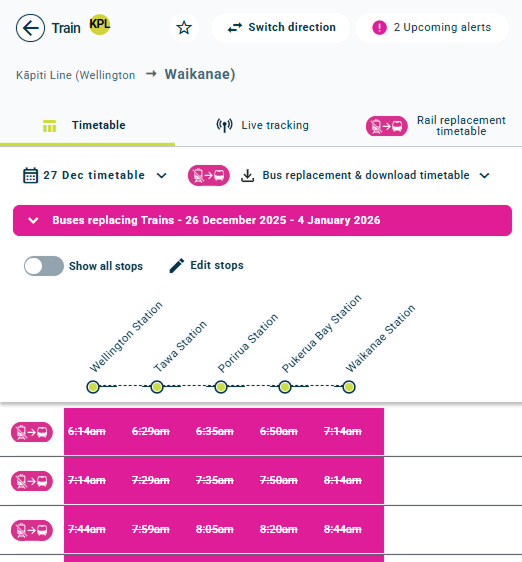
Rail trips that are bus replaced are highlighted in pink
Finding the bus replacement PDF on the train timetable page:
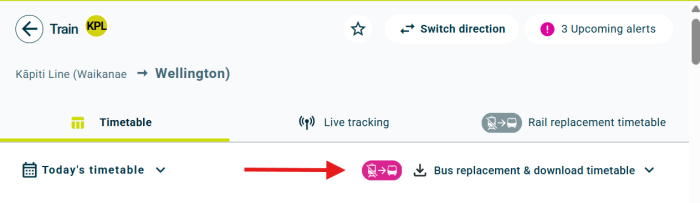
You can now find the Buses Replacing Trains timetable directly on the online timetable page for each train line.
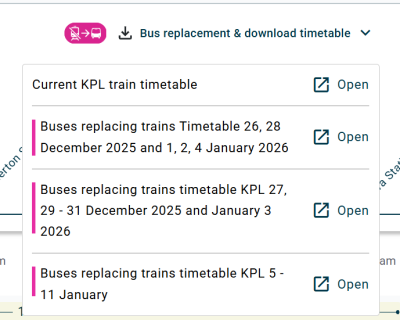
Services that are replaced by buses will be shown in pink on the timetable. For those days, PDF timetables can be accessed by clicking the “Bus replacement and download timetable” button. This button opens a dropdown menu containing the available PDF timetables.
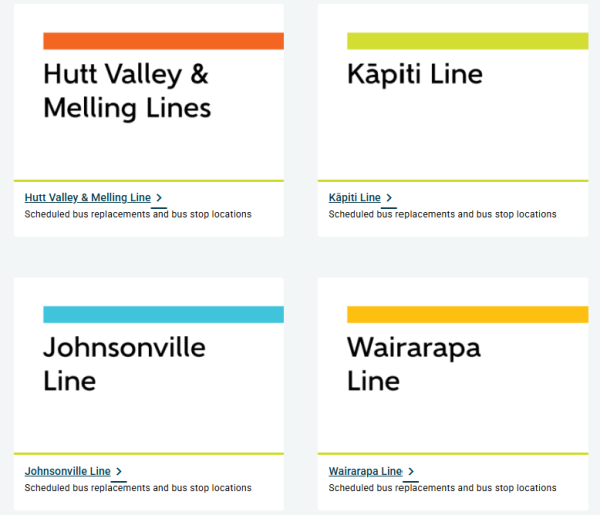
Finding the bus replacement PDF on the Buses Replacing Trains page:
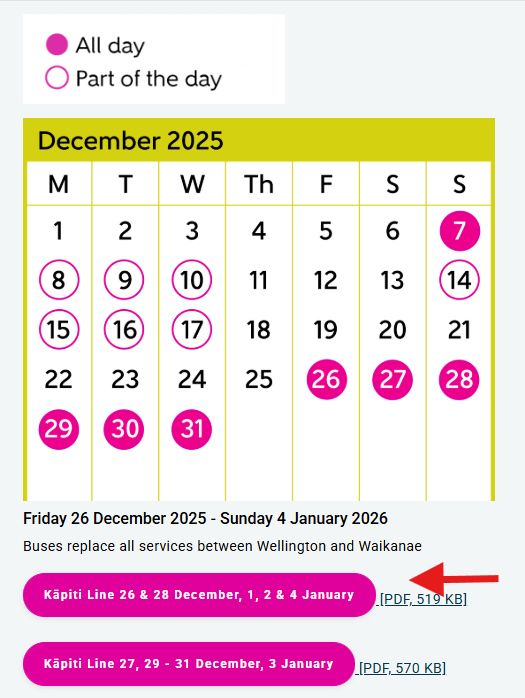
Using buses replacing trains
Hot pink signage is being rolled out across the network to help passengers find bus replacement stops and information. Directional signage and bus replacement timetables are posted at each station, and station maps can be found on freestanding information totems on platforms at all suburban train stations.
Most buses replacing trains are planned in advance for maintenance or important trackwork. Schedules and timetables will be posted on this page and in service alert notifications. Buses replacing trains timetables and calendars will also be posted at train stations.
Buses replacing trains have different journey times than trains, and may be different to your regular train departure times. Service alerts will detail which services are replaced by bus. Planned bus replacement schedules and timetables can be viewed by selecting a train line above.
Buses replacing trains are not regular bus services. They do not have online timetables or display in the journey planner, and bus arrivals do not display the real time information online or at bus stops. Service alert messages will display on real-time information displays on the train platforms, however.
Buses replacing trains have longer journey times than train services due to traffic and station access for vehicles, like large buses. When a portion of a train line is replaced by bus - for example between Porirua and Waikanae - buses are scheduled to connect with train arrivals and departures, but may not always be timed perfectly due to the above reasons.
Buses replacing trains are not regular bus services, so they don't have online timetables like regular bus routes, or display in the journey planner. They do not appear on real time information displays.
Buses replacing trains are not tracked by GPS, so the bus arrivals do not display as real time information online or at bus stops. Service alert messages will be displayed on real-time information displays on the train platforms, however.
Bus stops
Some bus replacement stops are directly outside the station or in the Park & ride (carpark). Others are combined with regular bus stops, which may not have shelter or seats available. In some cases, bus replacement stops are a short walk from the station, due to limited vehicle access to some stations. It's a good idea to check both your departure and arrival stations for bus replacement stops, so that you can adjust your journey plan, if needed.
Stop locations are visible on the map by selecting "Buses replacing trains bus stops" from the Show on map tab.
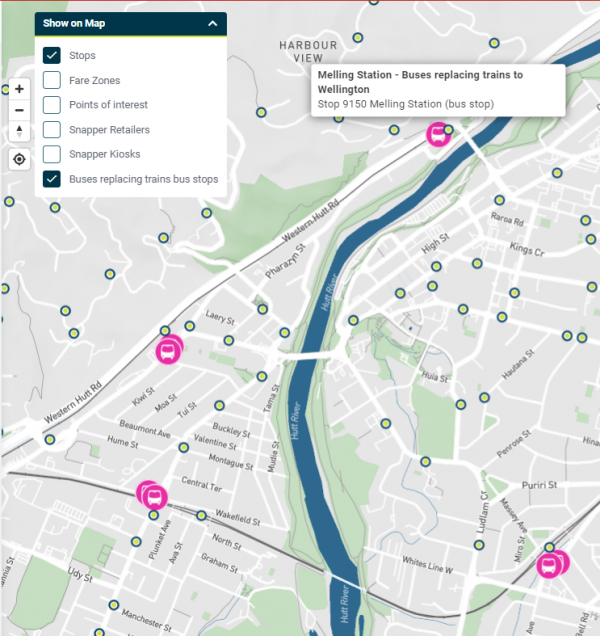
Which bus to catch
Most buses have electronic signs on the front that will say where the bus is going, and whether it is stopping at all stations or running an express service. Please ask on-board staff if you are unsure which bus to catch.
Paying your fare
Standard fares apply when you travel on a rail replacement service. Fares can be paid for using Snapper, contactless VISA or cash.
Where to tag on and tag off
Hutt Valley, Melling, Kāpiti or Johnsonville Lines
For rail replacement buses on the Hutt Valley, Melling, Kāpiti and Johnsonville lines, passengers need to tag on and off using the card readers inside the bus, near the front and back doors.
Wairarapa Line
For rail replacement buses on the Wairarapa Line, tag on at the platform card readers at the station platform before boarding the replacement bus. Tag off at the platform card reader at the station platform when you reach your destination.
If you are boarding the bus in Greytown, use the Snapper card reader located outside 73 Main Street (Studio 73).
Tagging on and off for multi-part journeys
If your journey includes both a train and a rail replacement bus, tag on and tag off for each part of your journey.
Transferring from a train to a rail replacement bus:
-
Before boarding the train: Tag on at the platform card reader.
-
When getting off the train: Tag off at the platform card reader.
-
When boarding the rail replacement bus: Tag on using the card reader on the bus.
-
When getting off the rail replacement bus: Tag off using the card reader on the bus.
Transferring from a rail replacement bus to a train:
-
When boarding the rail replacement bus: Tag on using the card reader on the bus.
-
When getting off the rail replacement bus: Tag off using the card reader on the bus.
-
Before boarding the train: Tag on at the platform card reader.
-
When getting off the train: Tag off at the platform card reader.
Planning your journey
If you have mobility requirements, please contact the Metlink Service Centre on 0800 801 700 or talk to a Metlink staff member to help plan your journey.
Accessible buses
Wherever possible, scheduled rail replacement services use Metlink-standard buses with accessibility features such as kneeling capability and priority spaces.
During unplanned disruptions, an accessible bus may not always be available.
Rail replacement services on the Wairarapa line are both coaches and a low-rider (low floor) bus. Coaches have stairs for boarding, while the low-rider bus can kneel and is fitted with a ramp, making it more suitable for customers who use mobility aids.
If you have accessibility requirements, we recommend contacting the Metlink Contact Centre on 0800 801 700 before you travel.
If an inaccessible bus arrives
Contact the Metlink Contact Centre on 0800 801 700. We will arrange an accessible vehicle, but you may need to wait longer.
Shuttles
Some shuttle services are not accessible for wheelchairs or prams.
Johnsonville Line
- Crofton Downs Station is serviced by a shuttle operating between Crofton Downs and Ngaio.
Hutt Valley Line
- Manor Park Station is serviced by a shuttle operating between Silverstream and Manor Park.
If you require an accessible service, please contact the Metlink Contact Centre on 0800 801 700 for assistance.
Boarding assistance
Drivers and staff can provide assistance when boarding. However, a seat or space cannot be guaranteed.
If you need assistance, speak with station staff or the bus driver, or contact the Metlink Contact Centre on 0800 801 700.
Bikes & prams
Bike racks on Metlink buses will be available to passengers by Tuesday 1 July 2025, once all buses requiring modification are compliant with the NZ Transport Agency (NZTA) industry alert. Learn more.(external link)
All folded prams can be carried on board the bus replacement services when stored in the luggage areas, non-foldable prams may not be able to be carried on all bus replacements, please talk to on-board staff when boarding.
Buses replacing trains will stop at every station's bus replacement stop. You do not need to press the red "stop" buttons to request the next stop. If you are unsure where your stop is, please ask on-board staff.
It's a good idea to check both your departure and arrival stations for bus replacement stops in advance, so that you can adjust your journey plans, if needed.
About planned network maintenance
Train lines are used all day every day of the year, so there’s not a time when the network isn’t being used, meaning from time to time works can cause bus replacements for passenger services.
We have a regular maintenance and renewal programme, which aims to improve the reliability of the Wellington commuter network. Work on the line which requires bus replacements are planned in advance, with the aim of keeping disruption to commuters to a minimum.
The majority of maintenance and upgrade work takes place at night or during weekends to avoid disrupting the thousands of passengers commuting in and out of Wellington on weekdays.
When we need to carry out major engineering work, such as replacing tracks or upgrading signalling systems, we may need to close a line or section of line for longer than 48 hours to complete the upgrade work efficiently and safely. For these larger scale works on the network we take advantage of the public holiday weekends at Easter, Queen’s Birthday, Labour Weekend and Christmas.
The signalling system directs trains around the network safely, and also keeps them spaced apart to avoid collision.
The signalling system is the brain that drives the points which direct trains where to go and also activates level crossing alarms when a train is approaching. During a maintenance period staff can replace the mechanical or electrical parts of points and repair or replace signals components.
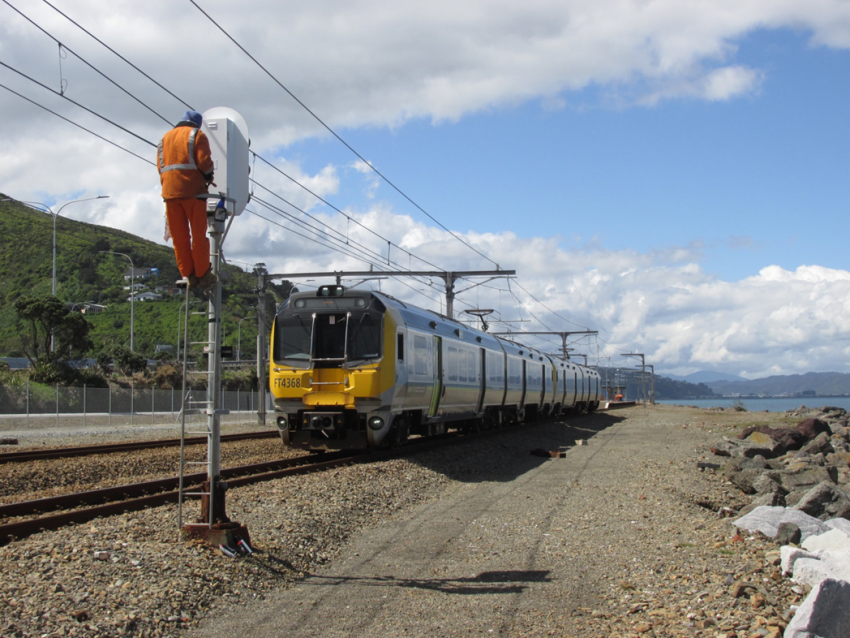
Signal maintenance on the Hutt Valley line.
This is the overhead power source that provides the electrical power to the Matangi units around the Wellington region. This includes the structures that support the wire, the overhead wires themselves, and the substations along the rail corridor that supply the power. During work on the network, traction staff perform general maintenance, inspections and replace sections of overhead wire or the structures that support it.
Traction staff are also responsible for making sure the overhead power is switched off during major works.
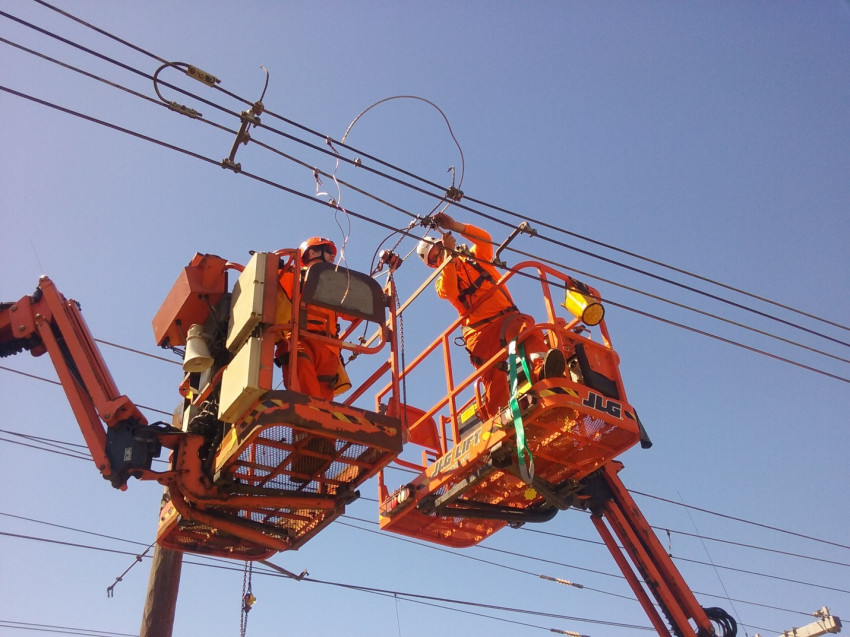
Traction staff working on overhead lines near Wellington station.
There are 60 bridges and 16 tunnels in the Wellington area. These vary in length from a few meters to the Remutaka tunnel which is 8.8km long, the second longest rail tunnel in New Zealand. During work on the network crews perform regular maintenance and inspections of these structures. During the longer maintenance periods bridge spans, sleepers and rail can be replaced, and strengthening can be carried out.
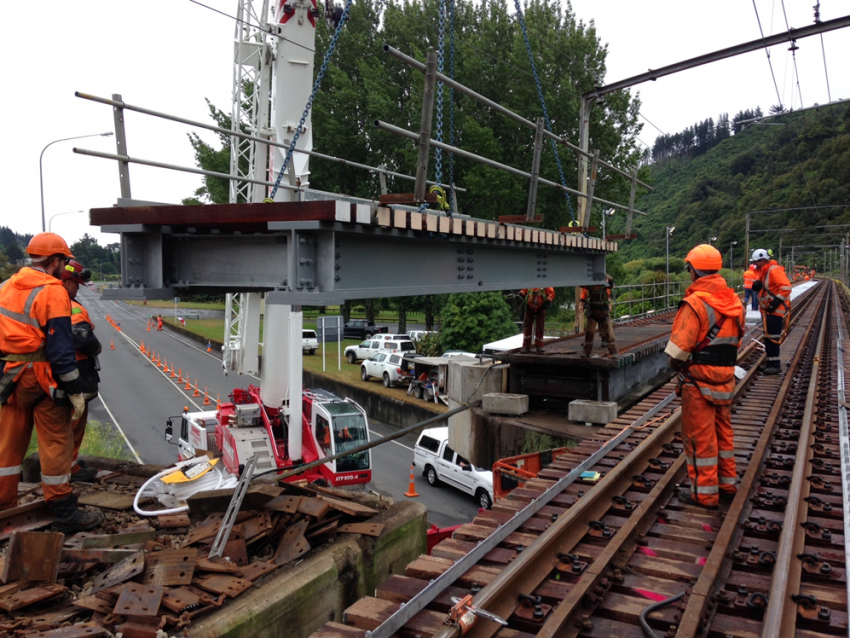
Bridge span being replaced on the Hutt Valley line.
During work on the network many other parties make use of the safe access to the rail corridor. Contractors trim and remove vegetation, repair platforms, spray weeds, remove graffiti, clear loose rock on cliffs, and remove dumped rubbish. Specialist railway machinery such as a Tamper/Regulator (machines used to align long sections of the track and compact the formation around the sleepers) or Ballast Cleaner are often used towards the end of a maintenance period to restore the line to normal.
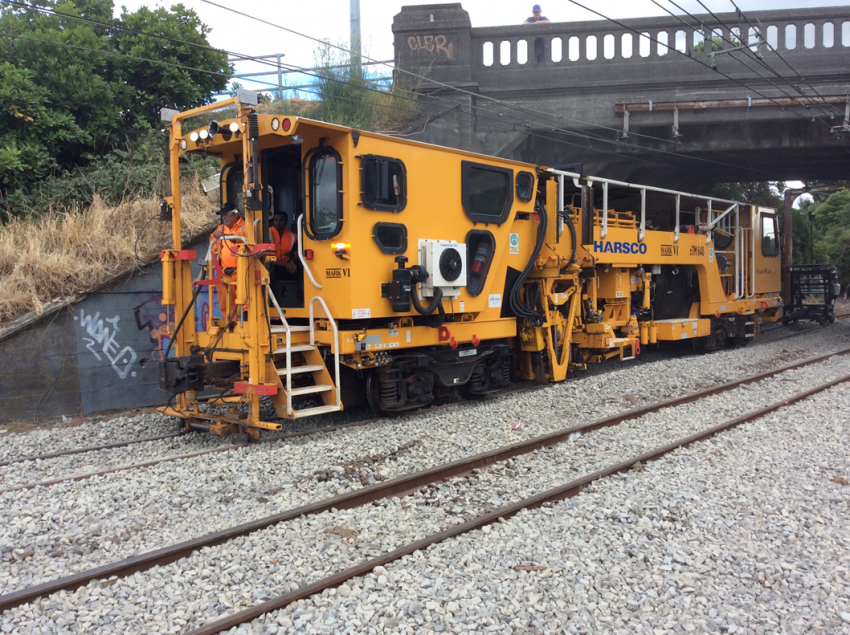
Tamper on the Hutt Valley line.
Last published: Thursday, 1 October 2026 at 4:19 pm